May 21, 2026
The Lightweight Race: Challenges and Breakthroughs in Aluminum Automotive Stamping
Switch a car body-in-white from steel to aluminum, and you drop the weight by 40% to 50%. For an electric vehicle, every 10% weight reduction translates to roughly 6% to 8% more range.
The math is simple. Every EV maker wants to use more aluminum. The problem is that aluminum behaves completely differently from steel on a stamping shop floor. Steel stays put in the die. Aluminum does not. Its springback is harder to predict. It tears more easily during forming. And the slightest bit of debris on the die surface leaves a visible mark on the finished part.
So aluminum stamping is not just “swap steel for aluminum.” It is a full rebuild of the material science, the forming process, and the die engineering behind every panel. Let me start with the most painful technical headaches, then move to the breakthroughs that have actually started to work in recent years.
Table of Contents
Why Aluminum Stamping Is So Much Harder Than Steel
Material Innovation: The Evolution Path from 5xxx to 7xxx
Process Breakthroughs: Hot Forming, Servo Presses, and Simulation-Driven Design
Application Reality: Aluminum Is Eating Steel’s Market Share
Summary
Why Aluminum Stamping Is So Much Harder Than Steel
Ask a veteran stamping operator what they fear most, and they will say two things: springback and splitting. Aluminum gives you both, and throws in surface sensitivity as a bonus.
Springback is far worse. The elastic modulus of aluminum is only about one-third that of steel. 5xxx-series aluminum sits around 70 GPa, 6xxx and 7xxx around 70–80 GPa, while mild steel is about 207 GPa. At comparable yield strength, aluminum springs back roughly three times as much as steel. You machine a die to the designed shape, the aluminum sheet is formed, it springs back, and the part is a few tenths of a millimeter off the print. Exterior body panels have extremely tight gap and flushness requirements. A few tenths of a millimeter of deviation shows up as a visible mismatch on the assembly line.
Splitting happens sooner. Steel has a high work-hardening exponent. During forming, localized deformation spreads to the surrounding material automatically. Aluminum has a much lower work-hardening rate. Strain does not diffuse effectively. Deformation concentrates locally, hits the forming limit curve quickly, and then the part tears. The limiting dome height for steel often exceeds 44 millimeters. For aluminum, it is typically only 20 to 25 millimeters. That is why the same part can be formed in steel without issue, but when you switch to aluminum, it cracks.
The surface is too soft. Aluminum is far softer than steel. It gets scratched or scuffed by the die surface much more easily during forming. One surface defect on an outer panel means scrap. And steel particles are catastrophic for aluminum surfaces. A tiny steel particle embedded in the aluminum surface creates a galvanic cell. A few weeks after painting, rust spots start to appear.
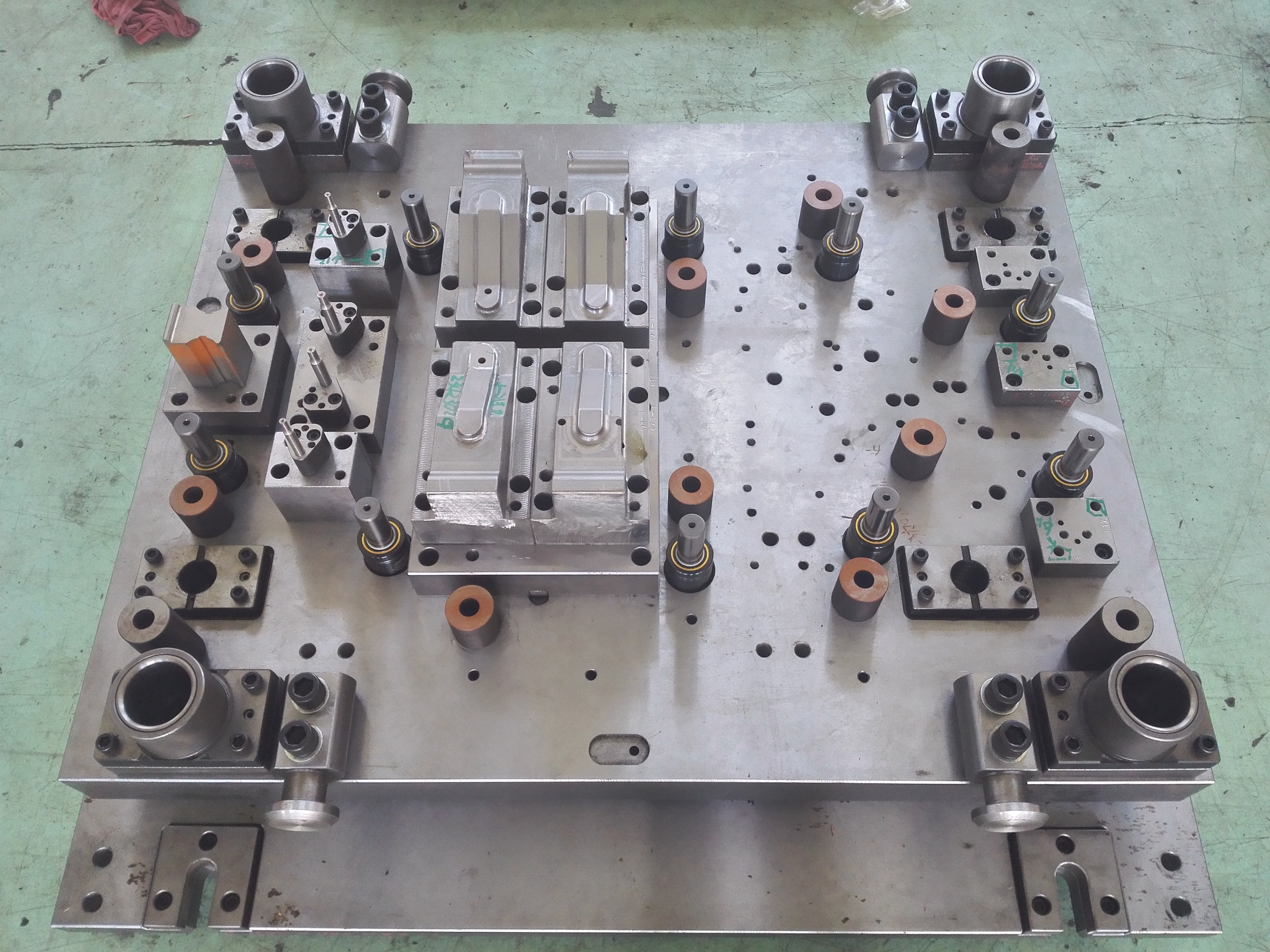
Dies cost more. Because aluminum has worse springback, splits more easily, and wears dies faster, aluminum stamping dies demand much more from material selection and engineering than steel dies. The die steel needs higher surface hardness and better wear resistance. The die surface often needs a special coating to reduce friction and protect the surface. A set of aluminum outer panel dies costs significantly more than an equivalent set of steel dies.
Material Innovation: The Evolution Path from 5xxx to 7xxx
You cannot just grab any aluminum alloy and stamp an automotive body panel. From 5xxx to 6xxx to 7xxx, each series has its own territory.
5xxx-series aluminum (Al-Mg) is the old workhorse for stamped parts. 5052 and 5182 have good formability and a relatively higher work-hardening rate. They are generally used for body inner panels and structural parts of moderate complexity. However, 5xxx aluminum continues to age at room temperature after stamping, which can cause yield point elongation. Tensile strain creates visible “stretcher strain marks” on the surface. This is absolutely unacceptable for exterior panels, so outer body panels almost never use 5xxx.
6xxx-series aluminum (Al-Mg-Si) dominates outer panels. 6016 and 6111 gain significant yield strength during the paint bake cycle through bake hardening, while maintaining good formability. They are the right choice for doors, hoods, and fenders. The formability of 6xxx aluminum is slightly lower than 5xxx, but surface quality is far superior.
7xxx-series aluminum (Al-Zn-Mg-Cu) delivers the highest strength. 7075 alloy can achieve a yield strength above 500 MPa, far higher than most 6xxx alloys. Its main application is hot-stamped B-pillars, roof rail reinforcements, and rocker reinforcements—areas where crash safety is critical. But 7xxx aluminum has poor room-temperature formability. It can barely be formed into complex shapes cold, so the hot forming route is mandatory. Moreover, 7xxx aluminum is sensitive to stress corrosion cracking. Alloy development and heat treatment optimization are ongoing.
The material breakthrough direction is clear. First, develop 6xxx alloys with even better formability to expand the complexity of parts that can be cold-stamped. Second, develop matched hot forming and aging processes for 7xxx alloys to push them into more structural safety parts. Third, recycling. A large fraction of automotive aluminum comes from scrap remelting. How to precisely control alloy composition and properties at high recycled content ratios is a hard problem the whole industry is chewing on.
Process Breakthroughs: Hot Forming, Servo Presses, and Simulation-Driven Design
The inherent limits of aluminum are fixed. What can change is the process.
Hot forming and warm forming. 7xxx aluminum is difficult to form at room temperature. But heat it to the solutionizing temperature range of about 450–480°C, and formability improves significantly. This idea is used to manufacture complex structural safety parts. After forming, artificial aging pushes the strength back up. That is the basic logic of the HFQ (Hot Form Quench) process. The technical challenge lies in precisely controlling heating temperature, transfer speed, and die cooling rate. You need to find a narrow process window between formability and final strength. The TTP curve (Time-Temperature-Property curve) plays a key role in hot forming—it describes the final properties a material achieves after holding at a specific temperature for a specific time, and it is the core basis for setting the hot forming thermal schedule.
Servo presses. A traditional mechanical press has a fixed slide motion curve—a sine wave, non-adjustable. A servo press lets you freely program the stroke curve and use different speeds at different forming stages. Lower punch speed means lower strain rate. Lower strain rate means the aluminum’s forming limit goes up. Production data shows that servo presses can deliver 20% to 30% improvement in cycle time for aluminum stampings compared to traditional mechanical presses.
Simulation-driven die design. You cannot fix aluminum springback just by tweaking the die on the tryout bench. You must calculate the springback amount using finite element simulation at the die design stage and machine the compensation directly into the die surface. LS-DYNA and AutoForm are the industry-standard software tools. The Yoshida-Uemori and Barlat 2000 material models can reasonably describe the mechanical behavior of aluminum under anisotropic yielding and cyclic plastic deformation. Springback compensation is an iterative process. It usually takes two to three rounds of simulation to get the springback-compensated shape to converge within tolerance.
Application Reality: Aluminum Is Eating Steel’s Market Share
The global automotive aluminum body sheet market is expanding fast. It was valued at roughly USD 18.41 billion in 2025 and is projected to reach USD 41.26 billion by 2033, a CAGR of about 10.6%. North America and Europe are the two largest markets. But Asia-Pacific—especially China—is the fastest-growing region, driven by rapid growth in new energy vehicle production and continuously tightening lightweighting regulations.
The rise in aluminum content per vehicle is especially clear in premium models. A typical luxury EV body-in-white often contains over 200 kilograms of aluminum. Outer panels use 6xxx-series aluminum sheet almost exclusively. Structural parts use a mix of aluminum castings, extrusions, and stampings. Even in cost-sensitive mid-market segments, the penetration rate of aluminum stampings is climbing steadily, concentrated on parts with the best weight-saving payoff: hoods, fenders, and liftgates.
Three main forces drive this growth: the EV industry’s relentless pursuit of range, global emissions regulations putting continuous pressure on lightweighting, and the steady progress of aluminum sheet and stamping technology itself, which is bringing total cost gradually closer to an acceptable range.
Summary
Aluminum stamping is at a point of rapid iteration.
On the technology side, 5xxx handles structural parts, 6xxx handles outer panels, and 7xxx enters safety structural parts through hot forming. Three material classes, each with its own job. Servo presses give controllable forming speed. Simulation tools make springback compensable. Hot forming processes are pulling 7xxx aluminum’s potential from the lab onto the production floor.
On the market side, the global automotive aluminum body sheet market exceeds USD 18 billion and is growing at over 10% annually. EVs are the main push, but lightweighting regulations affect all powertrain types.
Unsolved problems: The forming limit of aluminum is still far below steel. The calculation accuracy and iteration efficiency of springback compensation still need improvement. How to maintain compositional consistency at high recycled content while guaranteeing performance remains a challenge.
The lightweighting advantage of aluminum in automotive stamping is physically already on the table. What remains is to bring its forming difficulty, die cost, and surface quality to an engineering maturity level that is commensurate with its lightweighting benefits. That has been the theme of the past decade. It will be the theme of the next one as well.