September 23, 2026
Laptop and Home Appliance Stamping Components with Strict Quality Standards
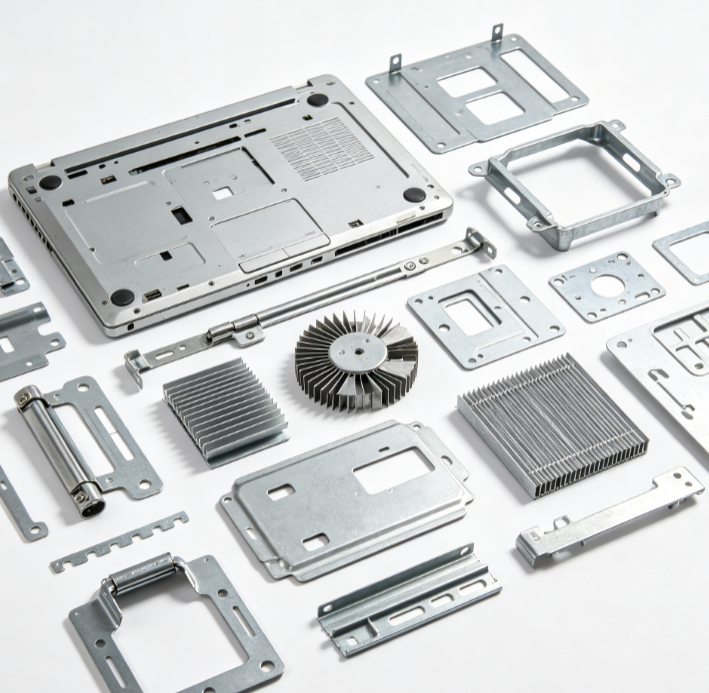
Table of Contents
1. Application Background of Laptop and Home Appliance Stamping Components
2. Types of Stamping Components
3. Manufacturing Processes and Key Technologies
4. Quality Standards and Inspection Methods
5. Quality Control Systems
6. FAQ
1. Application Background of Laptop and Home Appliance Stamping Components
Stamping components are indispensable structural and functional parts in laptops and home appliances. In laptops, stamped parts are used in housings, thermal modules, EMI shields, hinges, and internal brackets. In home appliances, stamped parts are widely used in exterior panels, control panels, internal structural components, and heat dissipation parts. The quality of these components directly affects mechanical strength, electromagnetic compatibility, heat dissipation performance, and appearance quality of the final products.
As consumer electronics move toward thinner, higher-performance designs, and home appliances evolve toward smarter, more aesthetically pleasing products, higher demands are placed on the precision, surface quality, and consistency of stamping components.
2. Types of Stamping Components
2.1 Laptop Stamping Components
·
Housing Components: A-cover, B-cover, C-cover, D-cover
·
·
Internal Structural Components: Keyboard brackets, battery brackets, HDD brackets, motherboard brackets
·
·
Thermal Components: Heat dissipation fins, thermal brackets, fan brackets
·
·
EMI Shielding Components: Shielding covers, shielding clips
·
·
Hinge Components: Hinge brackets, pivot fixing parts
·
2.2 Home Appliance Stamping Components
·
Exterior Panels: Refrigerator door panels, washing machine panels, air conditioner panels
·
·
Internal Structural Components: Compressor brackets, motor brackets, guide rails
·
·
Heat Dissipation Components: Condenser fins, evaporator fins
·
·
Control Panels: Control box brackets, display panel brackets
·
·
Decorative Components: Decorative strips, nameplate brackets
·
3. Manufacturing Processes and Key Technologies
3.1 Stamping Processes
·
Blanking and Piercing: Sheet separation and hole processing
·
·
Bending Forming: Angle and shape forming
·
·
Drawing Forming: Deep drawing forming
·
·
Fine Blanking: High-precision shearing
·
3.2 Die Technologies
·
Progressive Dies: Multi-station continuous stamping
·
·
Compound Dies: Multi-operation compound stamping
·
·
Precision Dies: High-precision die manufacturing
·
3.3 Auxiliary Processes
·
Deburring: Burr removal
·
·
Cleaning: Surface cleaning
·
·
Surface Treatment: Electroplating, coating, anodizing
·
4. Quality Standards and Inspection Methods
Inspection Item | Inspection Method | Typical Requirement |
Dimensional Accuracy | CMM, Optical measurement | ±0.05mm |
Flatness | Feeler gauge, Optical measurement | ≤0.1mm |
Surface Roughness | Roughness tester | Ra≤0.8μm |
Burr Height | Microscope measurement | ≤0.05mm |
Material Hardness | Hardness tester | Per drawing requirements |
Salt Spray Test | Salt spray chamber | 48-96 hours |
Adhesion Test | Cross-cut test | ≥4B |
5. Quality Control Systems
·
Incoming Material Inspection: Material thickness, hardness, and surface quality inspection
·
·
In-Process Inspection: First-piece inspection, patrol inspection, and last-piece inspection
·
·
SPC Control: Statistical process control for critical dimensions
·
·
Die Maintenance: Regular die maintenance and life management
·
·
Traceability: Batch management and quality records
·
6. FAQ
Q: What are the typical precision requirements for laptop stamping components?
A: Key dimensional tolerances for laptop stamping components are typically ±0.05mm, with some precision components requiring ±0.02mm. Flatness requirements are typically ≤0.1mm.
Q: How is burr controlled in stamping components?
A: Burr is controlled through die clearance adjustment, stamping process parameter optimization, and post-processing deburring processes.
Q: What are the surface quality requirements for home appliance stamping components?
A: Home appliance stamping components have high surface quality requirements, requiring no visible scratches, dents, or rust. Proper pre-treatment is required before surface finishing.
Q: What dimensional inspection methods are used for stamping components?
A: Common inspection methods include CMM, optical projectors, calipers, and specialized gauges.
Q: How is quality consistency ensured for stamping components?
A: Quality consistency is ensured through die precision control, stable stamping process parameters, SPC statistical process control, and regular die maintenance